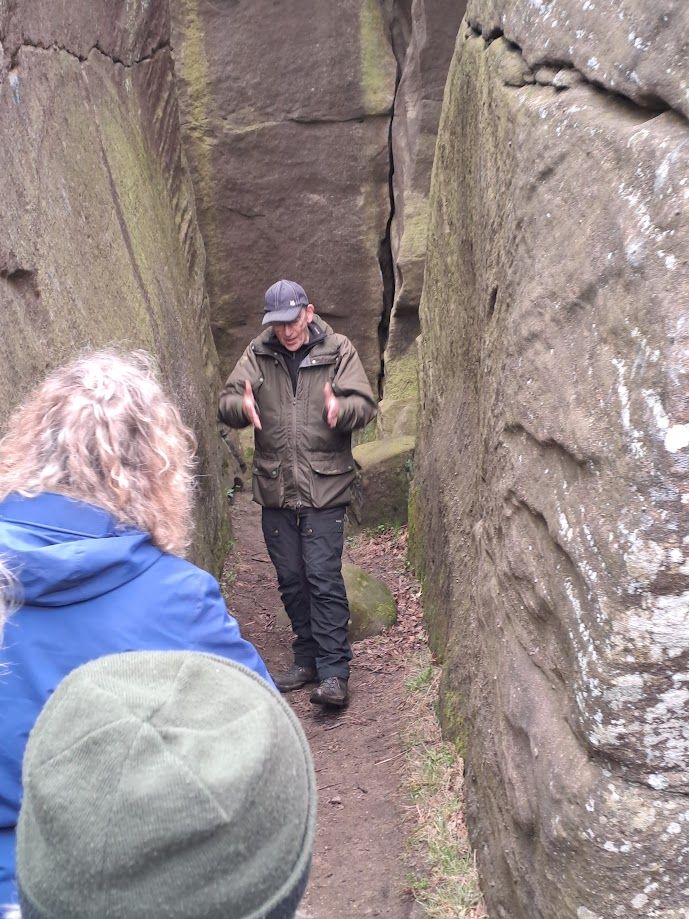
A number of keen HDNS members have now experienced a detailed Geology Walk and Talk around Brimham Rocks, led by Dr Stephen Lewis. Stephen gave HDNS this kind offer at the start of his lecture to members last October. The flurry of members eager to join meant that Stephen, who volunteers on behalf of the National Trust, agreed to lead this Geology Walk and Talk twice for us, on 2 consecutive Fridays this March 13 and 20.
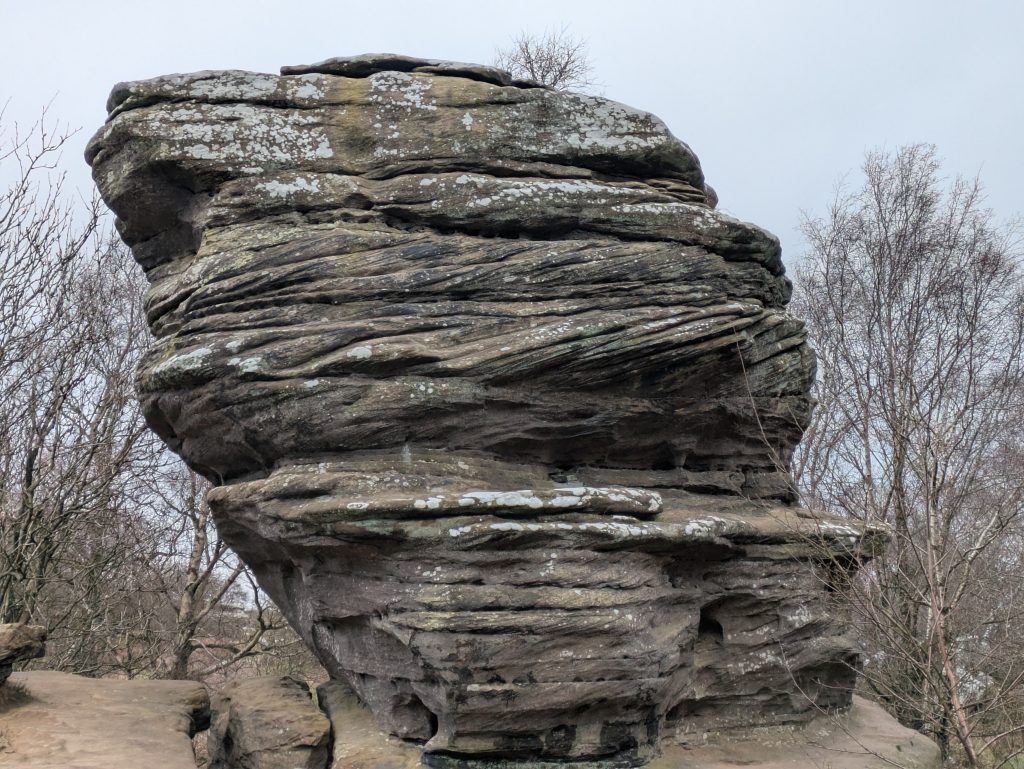
Stephen emphasized that, only last century, careful study of these wonderful rock formations by geologists has ensured that various myths and legends regarding their creation have finally been dismissed. 21st C geologists are still researching into the formation of these features. This research benefits from Stephen’s own close observations, and from the recent input of PhD student Roman Soltan’s. Stephen told us that, around 320 million years ago, where we were standing was not land but a wide river delta. Here the river was diverted into many channels, with water flowing over and around areas of deposited sand, grit, feldspar and rounded pebbles of quartz, forming a ‘braided delta’. The weight of river water compressed these deposits into solid rock, layer upon layer, rock now known as Millstone grit, as the hard, coarse grains give friction ideal for grinding. The water level dropped exposing the rock. Erosion by grit and quartz carried in the wind excavated the weaker rock, emphasized these layers and created these extraordinary shapes (photo 1).
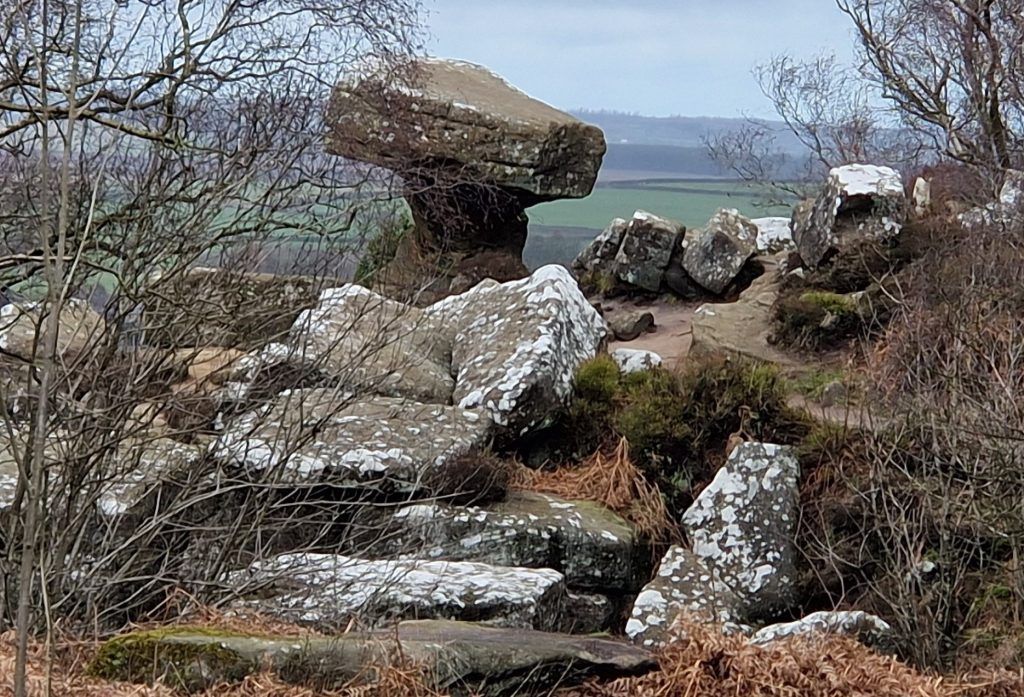
We were reminded that, as visitors to Brimham Rocks, we were following a tradition that started in 1700s. These first visitors believed that these rock stacks were man-made, the remains of an area sacred for Druid worship, and rocks hand carved. The names of some of the rocks stem from this myth such as the Idol rock (photo 3), and the Druid’s Writing Desk (photos 4). Further details of the history of this area can be read via the internet. Stephen highlighted that Brimham Rocks holds an SSSI notification. This classification was first given in 1958, as an outcrop of Millstone Grit, valuable for the natural birch woodland, areas of wet and dry heath and bog, for the plant communities, and wildlife including breeding birds. This status was revised in 1984 and 1988 and still stands. Since 1970 Brimham Rocks has been in the care of the National Trust. A team of staff and volunteers help to conserve the biodiversity on the moorland, using varying techniques to prevent bracken and birch growth. In the summer months there is now additional help from a herd of 30 Belted Galloway cows who will munch and trample on new growth of these plants.
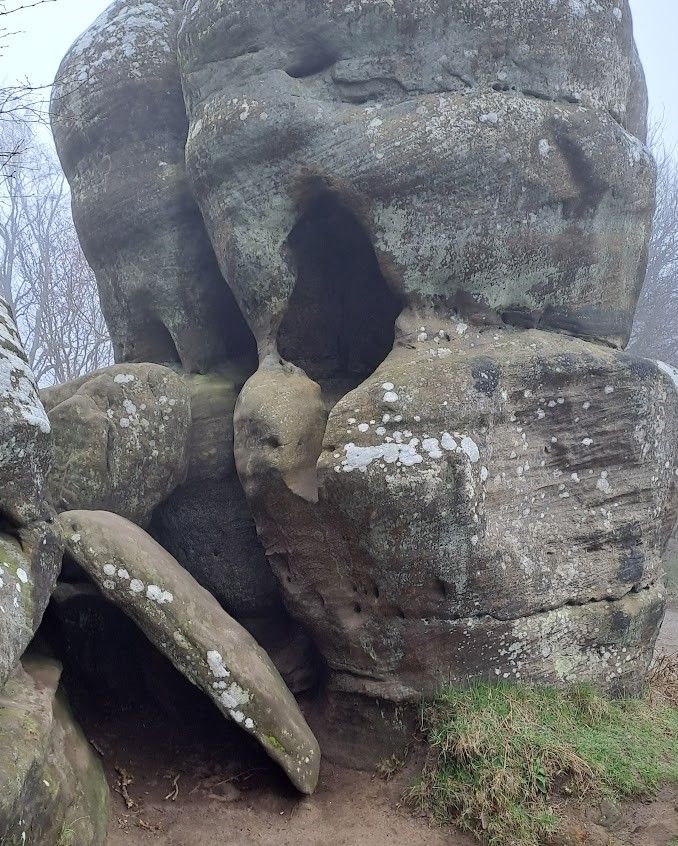
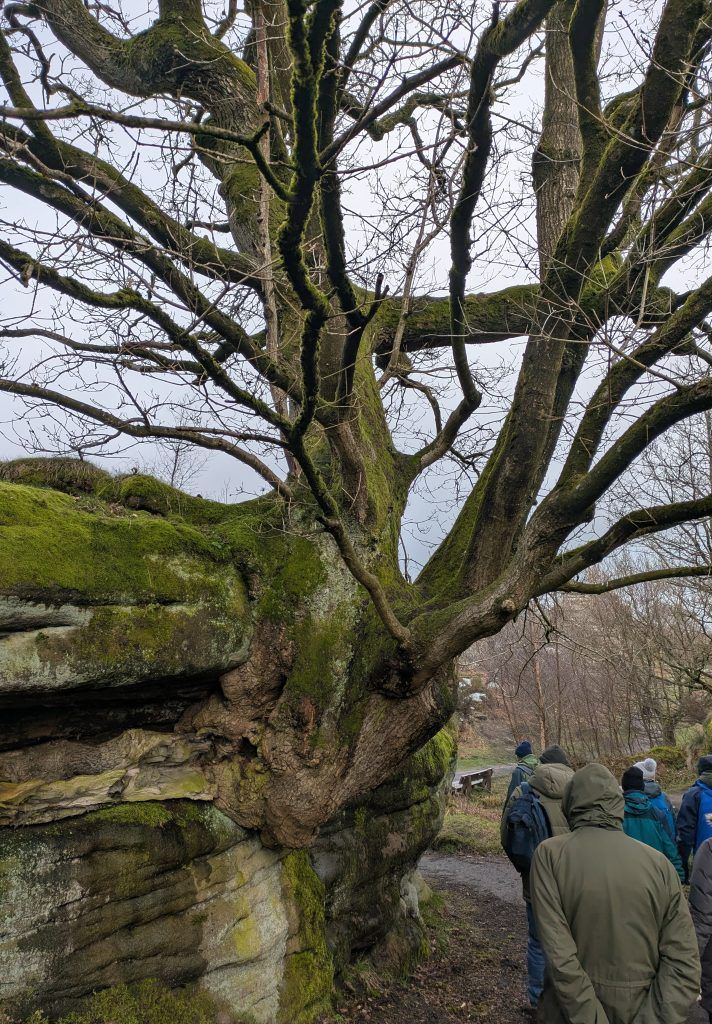
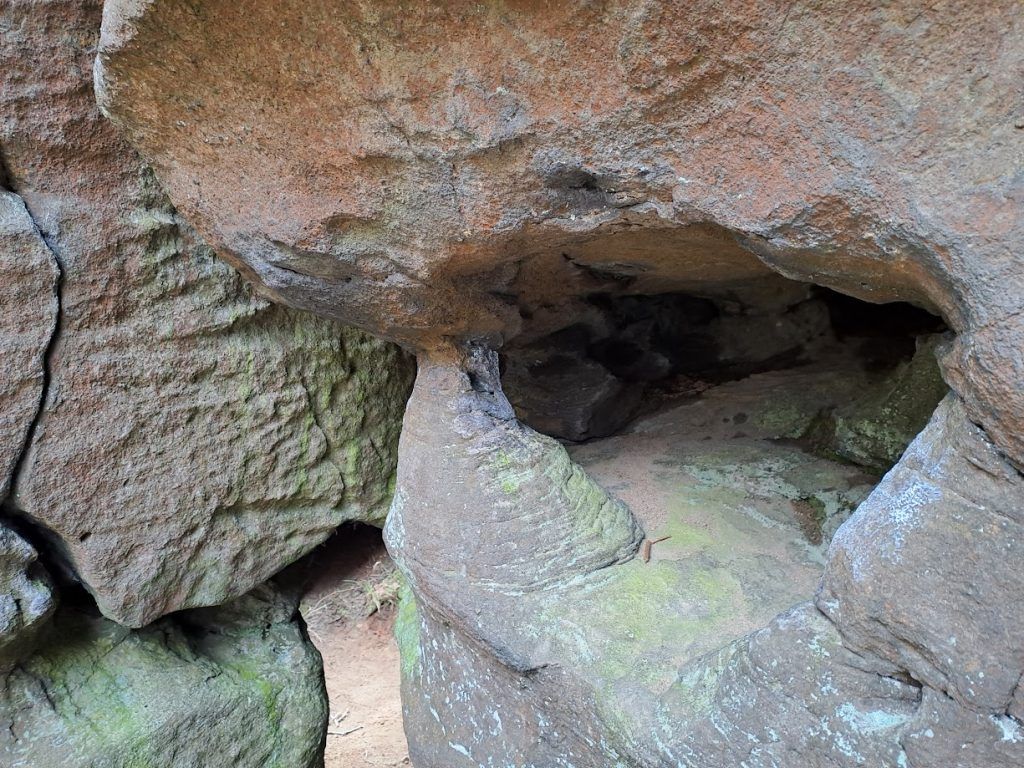
Stephen has a chosen route that enables him to show features visible on maybe only specific rocks, as well as retelling details of the geological history of the rocks. He showed us so many examples of ‘tucked away’ geological features, and/or historical interest that were new to us. This report will attempt to give details of barely a third of his information! Our first stop was at The Oracle (photo 2). Standing here, visitors were encouraged to put their own question to this rock and within a few minutes they would receive a response, courtesy of a very small person hidden within! We then passed a very old oak with roots pushing back into the rock itself (photo 3). It is thought to be around 400 years old. The lack of soil has limited its growth. A little further on we had a fine view of Druid’s Table or Writing Desk, (photo 4) and beyond across Nidderdale. Visitors today have also seen a resemblance of this stack to that friendly character from Outer Space, E.T!
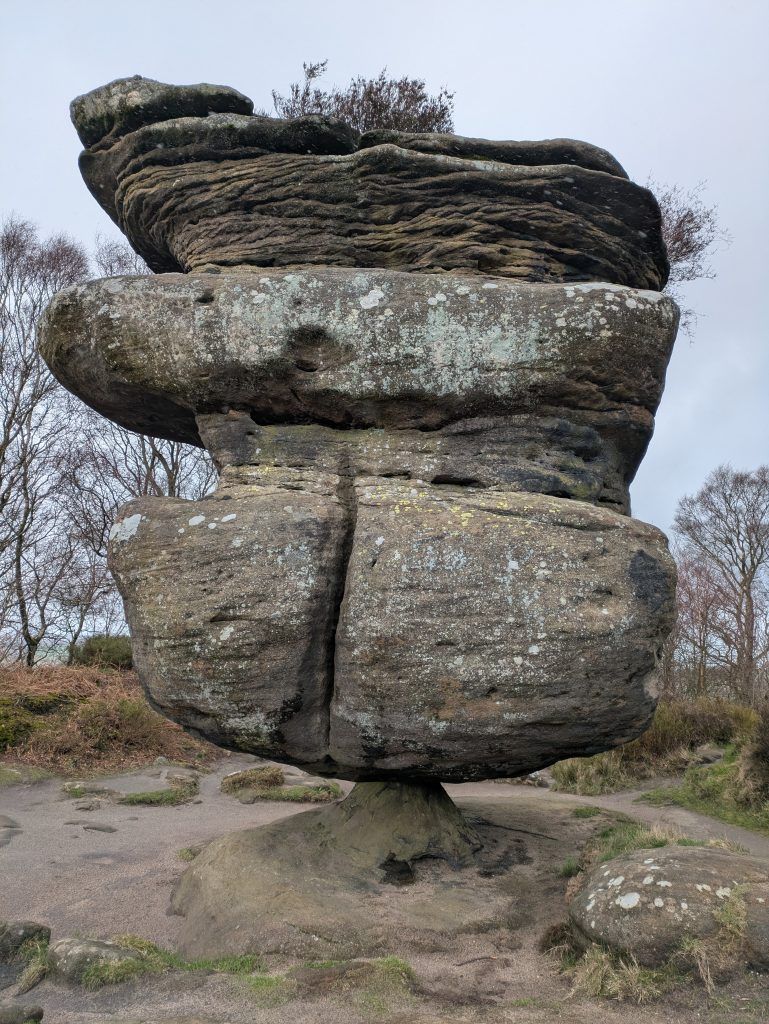
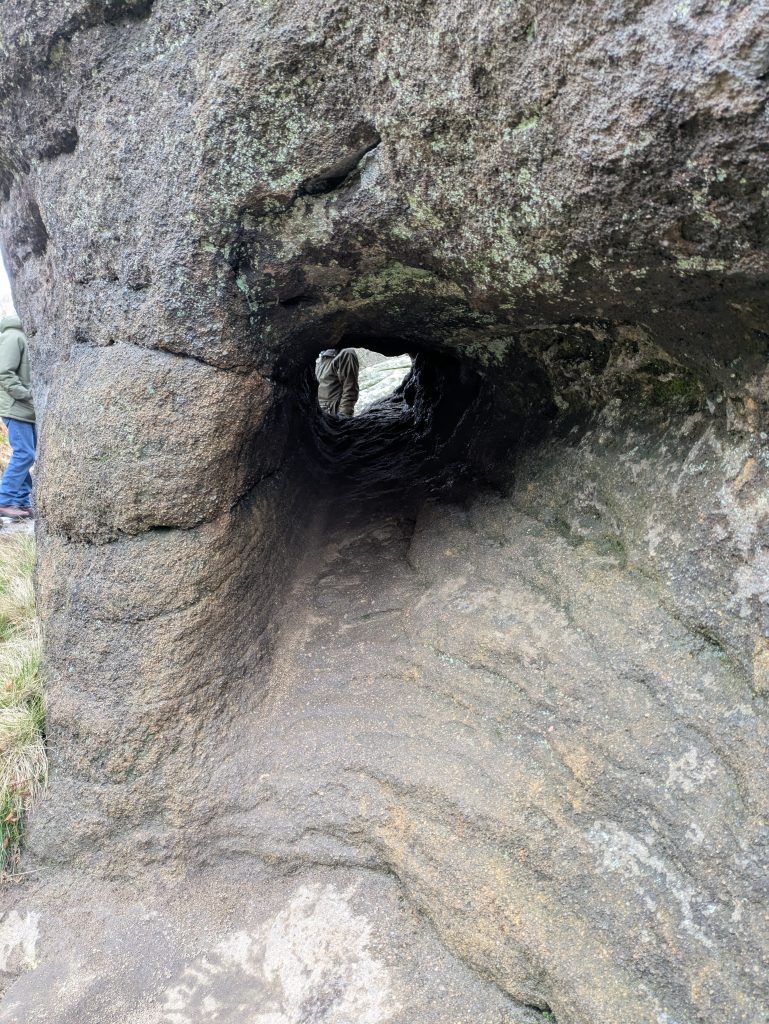
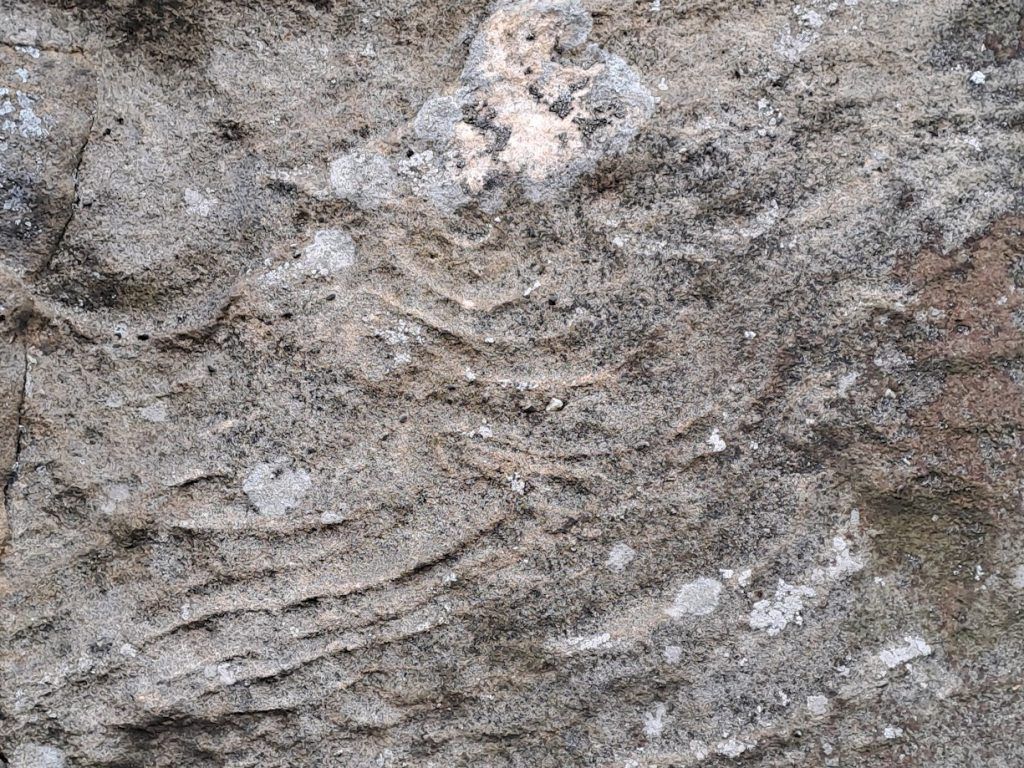
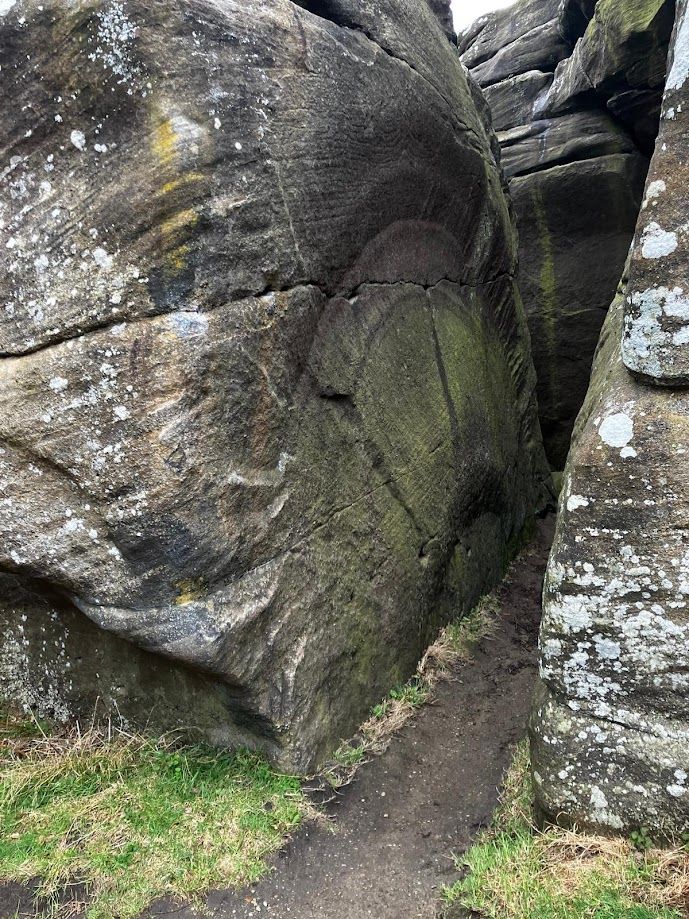
Our next stop was beside Icon Rock, a rock that has recently been included on a list of the World’s Most Ridiculous Rocks, maybe ‘precarious’ is the better description (photo 5). While erosion by wind has worn away the softer rock, the constant pressure from that huge mass weighing down on that remaining tiny pillar has caused compression, hardening that pillar and increasing its resistance. Although the Idol Rock has been passed as safe by National Trust Civil Engineers, they do also believe that it is only a matter of time before one day that boulder will topple! Nearby is the Wishing Rock (photo 6). The tradition here is to loop your arm around the rock and make your wish. This sounds considerably easier than attempting to crawl through the Smartie Tube (photo 7)! Ridges and swirls can be seen on many of the boulders we passed (photo 8). Stephen explained that these formations were due to pressure on layers of deposits, from below or above, rather like the patterns formed on sandy beaches (photo 8). At our last stop we learnt about the most recent discovery of a number of rocks that show a process known as Cocoloidal Split. Stephen helpfully demonstrated this to us (photo 9). The markings on one rock face can be seen in photo 10. These markings are replicated on the opposite rock face.
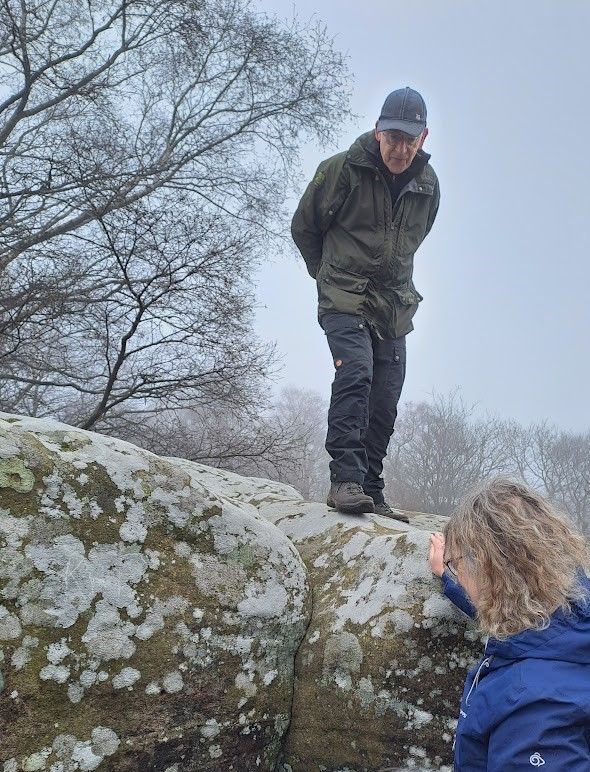
Stephen explained detailed geology in a light-hearted and enthusiastic manner. His last demonstration of this was close to the end of our visit, when Stephen was suddenly up on top of a boulder (photo 11). He then requested for the rock to be pushed……. surprising us with the fact he was standing on one of the few rocks at Brimham that rocks!
This report can only include some of the information that Stephen gave us and highlight some of features that he selected to show to us. However Stephen does offer these Geology Walks to the public. Details, dates and the chance to book can be found on the National Trust website.
Kerry Morrison