Starting early in the afternoon of 18 Nov eleven HDNS members had a really interesting walk, viewing and hearing details for the future of a number of large, currently empty fields, running down the southern side of the R Nidd. We were led around by Geoff Freeston and Shan Oakes, 2 key members of the KFP working committee. At various viewing points Geoff and Shan carefully explained possible plans that are being discussed. Having met the challenge of publicising and raising £900,000 to purchase these 60 acres, the challenge now is to ‘enhance biodiversity in as many ways as possible, alongside reconnecting public interest’. A ‘sister site’, Long Lands Common, opened in 2021, lies just a few fields away. These sites were brought into common ownership through Community Share Offer, their management teams share the same vision, and some of the same Committee members.
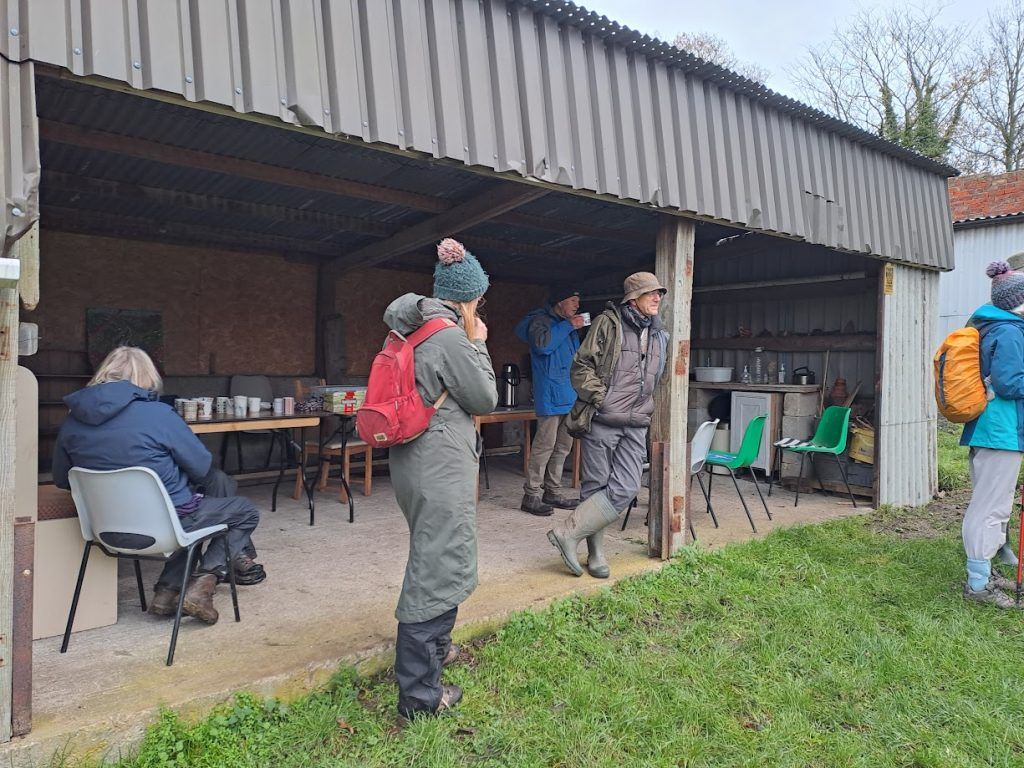
We set off by following the Beryl Burton Cycleway, leading us up Butler Hill (photo 1). Halfway up the slope, in the field, 2nd across to our left, we could see workmen and large diggers. Geoff explained that this was the early stages of the creation of 4 ponds, a project funded by Yorkshire Wildlife Trust (photo 2). The ponds will be excavated to the size and depth that will hopefully encourage Great Crested Newts to take up residence. Higher up the slope, on the left and alongside the Cycleway, is another field now part of KFP. The entrance to this field, from Bilton Hall Lane, now has a brand new 5 bar gate (photo 3). We walked a short way along the lane, as far as the allotments, and then took the footpath that drops back down Butler Hill. This footpath cuts through fields that now belong to KFP. The biodiversity of these fields is variable. They have stood unused for quite some time. The aspect and drainage of these fields will help the committee plan their future use. The plan for one field is to develop a wood pasture, with a mixture of habitats, groups of trees, open grassland and fallen trunks left to decay. One field could become a hay meadow. One field, where there is a marked slope might lend itself to be used as an open air theatre. Another field, one with low biodiversity, is earmarked to be replanted with willows, including at least 5 different varieties for their different winter stem colours (photo 4). There are so many uses for willow stems. The tallest stems can be used to create arches, domes and tunnels, shorter stems are popular for basket weaving and wreaths. A helpful bonus for management team are the remaining, not quite derelict farm buildings, now repurposed and known as The Garth (photo 5).
Now that this area is protected from development for the long-term public good the Committee hopes to involve shareholders, approximately 4,000, and local residents in the restoration of the natural environment. My own personal feelings are that our locality is so fortunate to have a group of residents who have worked so hard to achieve the purchase of these 60 acres to respect and protect it, and encourage it to flourish. We know that otherwise this land could have been covered by houses, tarmac and traffic.
This write up mentions only some of the information that Geoff and Shan gave us. For further information please do visit the KFP website https://www.knaresboroughforestpark.org/ also https://www.longlandscommon.org/
Kerry Morrison